

Understanding the Vital Signs of Tree Health in 2026
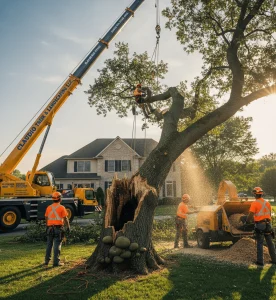
Trees are the silent guardians of our properties, providing shade, beauty, and significant value to our New England landscapes. However, there comes a moment when a tree shifts from being a backyard asset to a significant liability. Identifying that tipping point is crucial for your safety.
Many homeowners often struggle with the decision of whether to prune or completely remove a specimen. In 2026, with the increasing frequency of unpredictable weather patterns in Massachusetts and Connecticut, being proactive about tree risk assessment is more important than ever.
Waiting too long can result in catastrophic property damage or personal injury. This comprehensive guide will walk you through the biological and structural indicators that signal when tree removal services are the only responsible path forward.
The Biological Red Flags: When the Living Organism Fails
A tree is a complex living system, and like any living thing, it shows symptoms when it is failing. Recognizing these biological markers requires a keen eye for detail and an understanding of arboriculture.
If you notice significant changes in the bark, leaves, or growth patterns, the tree may be past the point of recovery. Let’s break down the primary biological indicators that suggest a tree’s structural integrity is compromised beyond repair.
Deep Vertical Cracks and Seams in the Trunk
A healthy trunk should be a solid, continuous pillar of support. When you see deep vertical fissures or cracks that extend through the bark into the wood, it indicates a structural failure.
These seams often suggest that the tree is literally splitting in two. In the industry, we call these “included bark” zones or “stress fractures” that cannot be healed by the tree’s natural defense mechanisms.
Widespread Internal Decay and Fungal Growth
Mushrooms or “conks” growing at the base of the trunk or on the main roots are a major warning sign. These are the fruiting bodies of fungi that feed on decaying wood.
If fungi are present, it means the interior of the tree is rotting. While some decay is manageable, widespread fungal growth usually means the root system or the core heartwood is no longer stable enough to hold the tree upright during a storm.
Structural Hazards and Environmental Displacement
Sometimes the tree itself is healthy, but its environment or its physical orientation makes it a ticking time bomb. Physical displacement often happens slowly over years or suddenly after a major weather event.
Structural hazards are particularly dangerous because they involve physics. A heavy canopy combined with a lean or a compromised root plate creates a lever effect that can easily crush a roof or power lines.
The Sudden Lean: Investigating Soil Heaving
Not all leaning trees are dangerous; many grow at an angle to find sunlight. However, if a tree develops a sudden lean, it is an immediate emergency.
Look at the ground on the opposite side of the lean. If the soil is cracked, heaving, or if you see roots lifting out of the earth, the tree is actively falling. This requires immediate intervention from professionals who handle emergency storm damage services.
Damage to the Critical Root Zone
The critical root zone is the area directly beneath the canopy. If you have recently performed construction, installed a pool, or paved a driveway near the tree, you may have severed vital anchor roots.
Without these anchors, the tree loses its ability to resist wind leverage. A tree with a compromised root system may look green and healthy for a season, but it lacks the physical connection to the earth required for long-term stability.
Comparing Tree Hazards: To Save or To Remove?
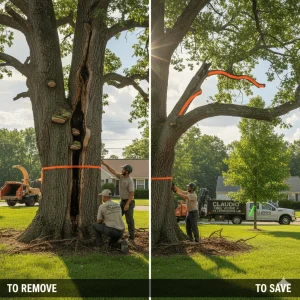
Deciding on the fate of a large tree involves weighing several factors. Below is a comparison table to help you categorize the severity of the signs you might be seeing on your property in 2026.
| Warning Sign | Severity Level | Recommended Action |
| Minor Deadwood in Canopy | Low | Professional Pruning |
| Large Hollow Cavity in Trunk | High | Professional Assessment |
| Fungal Brackets at Base | Critical | Immediate Removal |
| Heaving Soil/Lifting Roots | Emergency | Tree removal services |
| 50% or more of Crown is Dead | High | Removal Recommended |
| V-Shaped Narrow Crotch Union | Moderate | Cabling or Removal |
Proximity Hazards: When Location Becomes the Problem
A tree might be perfectly healthy but simply located in the wrong place. As trees grow, their footprint expands, and they can begin to interfere with the vital infrastructure of your home.
In urban and suburban areas like Quincy or Newton, MA, space is at a premium. Proximity hazards are one of the most common reasons for professional intervention to prevent long-term financial loss.
Encroachment on Power Lines and Utility Grids
Trees growing into high-voltage lines are not just a fire hazard; they can cause widespread blackouts. Utility companies often perform “hack-and-slash” pruning that leaves the tree ugly and imbalanced.
If a tree is consistently interfering with utilities, removing it and replacing it with a smaller, power-line-friendly species is often the best horticultural and safety decision.
Foundation and Hardscape Damage
While roots rarely “crack” a solid foundation, they can certainly exploit existing cracks or dry out the soil beneath a slab, causing it to settle and break.
If a large tree is planted within ten feet of your home’s foundation, the risk of water damage or structural shifting increases. Additionally, falling limbs over a roof can lead to shingle damage and gutter failure.
The 7 Definitive Warning Signs You Can’t Ignore
To simplify your inspection, we have compiled the seven most critical signs that indicate removal is no longer optional. If your tree exhibits more than two of these, you should act immediately.
-
The 50% Rule: If more than half of the tree is damaged or dead, it usually cannot recover its vigor or aesthetic value.
-
Hollow Trunk: If the trunk is a shell and more than 30% of the interior is decayed, the structural “column” is compromised.
-
Epicormic Sprouting: Small sprouts growing from the base of the trunk (water sprouts) are a sign of extreme stress. The tree is trying to survive by any means necessary.
-
Dead Branches on One Side: This often indicates root damage or vascular wilt on that specific side of the tree, making it lopsided and prone to falling.
-
Bark Inclusions: When two trunks grow so close that bark is trapped between them, they are not actually joined. They will eventually push each other apart.
-
Cavities and Nesting Holes: While great for wildlife, large holes in the main trunk or primary scaffolds indicate internal heartwood rot.
-
History of Limb Drop: Some species, like Silver Maples, are “self-pruning” and drop large limbs unexpectedly. This is a major liability in high-traffic areas.
Why DIY Tree Removal is a High-Stakes Gamble
It is tempting to grab a chainsaw and try to handle a tree yourself, but the physics of tree felling are incredibly complex. Every year, thousands of injuries occur due to “kickback,” “widowmakers,” and unpredictable “barber chair” trunk splits.
Professional crews use cranes, specialized rigging, and high-capacity wood chippers to dismantle a tree piece by piece. This controlled descent ensures that your house, your neighbors, and your family remain safe throughout the process.
Furthermore, removing the tree is only half the job. Professional services include stump grinding to ensure the area can be replanted or repurposed without leaving a decaying trip hazard in your yard.
Modern Arboriculture and Safety Standards in 2026
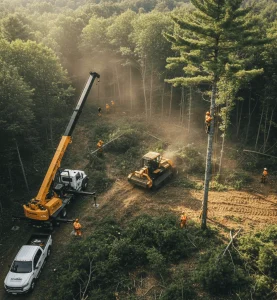
The industry has evolved. We no longer just “cut down trees.” We use precision felling techniques and biomechanical analysis to determine the safest way to clear a lot.
When you hire a licensed and insured team, you are paying for the expertise of people who understand how wind load, wood density, and gravity interact. This is especially true for trees that have been damaged by the intense New England winters we’ve seen recently.
Protecting Your Property Value
A well-maintained landscape can add up to 15% to your property value. Conversely, a dead or dying tree is a “deduct” in the eyes of any home inspector or insurance adjuster.
Removing a hazardous tree before it falls is an investment in your home’s equity. It allows you to plan the removal on your schedule rather than reacting to a middle-of-the-night emergency when a storm hits.
Taking the Next Step for a Safer Landscape
Identifying a dangerous tree is the first step; taking action is the second. You don’t have to make this decision alone. A professional evaluation can provide peace of mind and a clear plan of action.
Whether you need a single hazardous oak removed or a full acre cleared for new construction, the right equipment and experience make all the difference. Don’t wait for the next New England gale to test the strength of a questionable tree.
Ready for a Professional Assessment?
If you have seen any of the warning signs mentioned in this guide, it is time to consult with the experts. We provide detailed evaluations to determine the best course of action for your specific landscape.
Our team is equipped to handle the most complex removals in tight spaces across Massachusetts and Connecticut. We prioritize safety, efficiency, and leaving your property cleaner than we found it.
For a comprehensive evaluation of your property’s safety and to ensure your trees aren’t a hidden danger, you should request an estimate today.
Claudio Tree Work and Landscaping LLC is here to help you navigate these tough decisions with expert advice and professional execution.
Contact us today to schedule your consultation:
Call (203) 297-3522